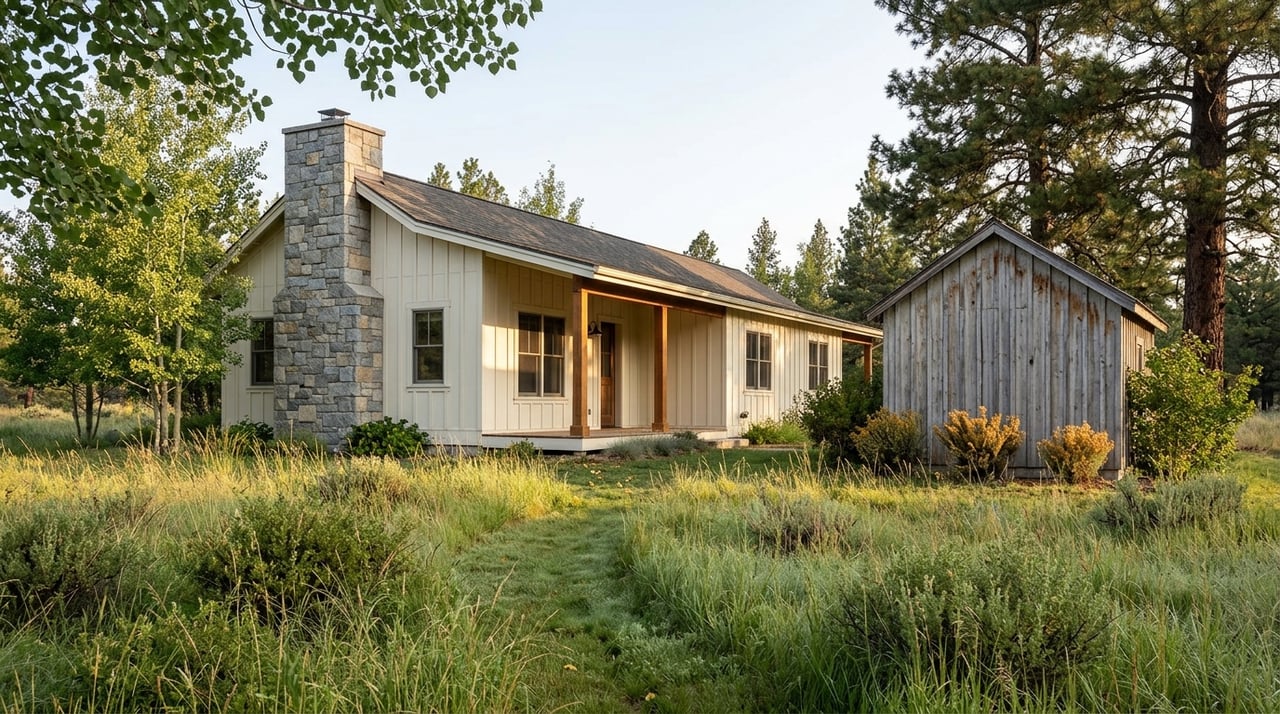
Say you're closing on five acres off a county road south of town. The listing mentions "irrigation rights" in passing, the way it might mention a metal roof or a Generac generator. You picture summer hay, maybe a garden big enough to matter, water moving through the old ditch that cuts along the property line. Then, a year in, you call the ditch company to ask about your turn in the rotation and learn the water right was never transferred to you at all. It's still sitting on paper with the previous owner, or worse, it was severed from the parcel decades ago and nobody updated the listing sheet.
That scenario is not rare in Carson Valley, and it's not really about bad luck. It's about how Nevada treats water. In this state, a water right is its own piece of real property, separate from the dirt it waters. It does not ride along with a deed automatically. If nobody in a Minden transaction handles that fact on purpose, the buyer can close on a beautiful piece of ranch country and still not legally own the water that made it worth ranch prices.
Water Is Not a Fixture. It Has Its Own Deed.
Nevada follows prior appropriation, the doctrine known as "first in time, first in right." Whoever put water to beneficial use first on a given source holds the senior claim, regardless of who owns the land today. Every right carries its own priority date, point of diversion, place of use, and purpose, tracked by the Nevada Division of Water Resources.
Because a water right is legally distinct from the land, a purchase agreement and deed need to reference it by name for it to transfer. Buying the parcel does not, on its own, guarantee you inherit the water that has historically served it. If a change of ownership isn't properly recorded with the state, there's no clean record that the transfer happened at all, which is exactly the kind of gap that turns into a dispute years later rather than a conversation at closing.
Minden Is Still Living Inside a 1980 Court Order
The reason this matters more in Minden than in most suburban markets is the Alpine Decree, the federal decree that settled surface water rights on the Carson River. Entered in 1980 under Civil No. D-183 BRT in U.S. District Court, it assigns water to parcels based on historic allocation rather than current lot lines. The Carson River itself forms near Genoa, where its East Fork and West Fork join before running north through Minden and Gardnerville, and every diversion along that stretch answers to the Decree's priority system.
Ed James, general manager of the Carson Water Subconservancy District, told Douglas County commissioners this year that the region's largest groundwater rights holders are the agricultural landowners who lean on supplemental rights when the river falls short of their Alpine Decree irrigation allotment. He also pointed out something buyers rarely think about:
"If you pump groundwater, it affects surface water and vice versa."
The same report named the valley's water purveyors, including Gardnerville Ranchos, Gardnerville Water Co., Indian Hills, and the Town of Minden, and noted that Minden and Gardnerville Ranchos are projected to need additional wells by 2051 to keep up with demand. None of that changes what happens at your closing table today, but it explains why the state, the county, and the ditch companies all keep such careful records of who holds what. Water here isn't a convenience. It's a finite, decreed resource with decades of paperwork behind every drop.
The Ditch Doesn't Belong to Whoever Lives Next to It
Carson Valley's irrigation network predates most of its subdivisions by a century. A 2002 profile of the valley's ditch system described a Water Conveyance Advisory Committee made up of working irrigators, including longtime rancher Johnny Indiano, who spent decades helping keep the valley's ditches clear. Board members observed even then that the ranchers who traditionally maintained those ditches were being replaced by homeowners who had no idea what they'd inherited along with their lot.
That distinction still trips people up. Many older Minden parcels carry shares in a private ditch company rather than an adjudicated water right filed with the state. Those shares control your place in line for water delivered through the ditch, but they are not the same legal instrument as a water right, and treating them interchangeably during a sale is one of the more common mistakes in rural Carson Valley transactions.
Before writing an offer on any Minden property with acreage, a well, or a ditch frontage, it's worth getting specific answers to a few questions:
- Is there an adjudicated water right tied to this parcel, and does its priority date and point of diversion match what the seller believes they own?
- If the property relies on a ditch, is the seller conveying shares in a ditch company, and is that share transfer separate from the land sale paperwork?
- Has a change of ownership for any water right ever been filed with the Nevada Division of Water Resources, or is the state's record still showing a prior owner?
- If irrigation matters to your plans for the property, has anyone confirmed actual delivery history rather than just the right's existence on paper?
The Well in the Yard Doesn't Settle the Question
A lot of buyers assume that if a property already has a well, the water question is closed. Nevada's rules complicate that. The state allows a domestic well exemption of up to 2.0 acre-feet for household use without a separate water right, but that exemption only applies to parcels that cannot connect to a municipal water system. If a lot could tie into Minden's town system or one of the local water companies, the domestic exemption may not apply the way a buyer expects, and new lot splits typically require purchasing 2.0 acre-feet of water rights for each new parcel served by a well. The presence of a wellhead tells you almost nothing about whether the underlying right is secure, transferable, or even properly permitted.
Why This Shows Up in the Price, Not Just the Paperwork
Minden's numbers this year make the stakes easier to see. Across the first half of 2026, the town's median sold price ran near $699,450 on Northern Nevada Regional MLS data, up roughly 11 percent year over year, with about 122 closings and homes averaging around 61 days on market. Genoa, just up the road, posted an even steeper 16 percent gain to a median near $1,319,950 in the same window, much of it tied to acreage and river-adjacent estates where water history carries real weight.
Those gains aren't evenly distributed across every acre. A five-acre parcel with a clean, senior Alpine Decree right and documented delivery history is not the same asset as a look-alike five acres down the road with a lapsed or unclear right, even if both list at similar price points. Appraisers and lenders increasingly ask about water documentation on rural files, and a murky water history can slow financing or shrink a buyer pool in ways a median price never captures. When you're comparing two Minden listings that look identical on paper, the water paperwork is often the real difference in what you're actually buying.
A Few Questions Minden Buyers and Sellers Ask
Does every Minden home need a water rights check? No. Homes on municipal water and sewer in town generally don't carry this complexity. It matters most for acreage, ranch-style parcels, and anything advertised with irrigation, a well, or ditch access.
Can water rights be sold separately from the land? Yes. Because they're treated as their own real property in Nevada, a seller can retain water rights even while selling the land, unless the purchase agreement and deed specifically include them. That's exactly why the wording matters.
Who do I contact to verify a water right before closing? The Nevada Division of Water Resources maintains the official records. For anything Alpine Decree related, the Carson Water Subconservancy District and the Federal Water Master's office are useful starting points, and a water rights attorney or licensed surveyor can confirm chain of title.
Water in Carson Valley has never been simple, and it was never meant to be. It's the reason this valley grows hay instead of sagebrush in places, and the reason a handful of ranching families still show up at meetings about ditches nobody else thinks about. If you're buying or selling a Minden property where water actually matters, that history deserves more than a line item on the listing sheet. Kaycee Summers has spent years walking Carson Valley clients through exactly this kind of paperwork, matched against exactly this kind of land. Let's Connect before you write the offer, not after.